The million-dollar question. Are the traditional PBX phone systems finally on their way out?
We’ve been discussing this shift from old telephony to cloud services for some time now. But as always it had polarising reactions. Some believed this was going to be a game changer, while others didn’t expect much to change save a switch from PSTN to SIP trunking. But finally, have we reached a place where we can say it’s time?
Iain Sinnott, Head of Customer Engagement at CloudClevr, explores this in this article.
Have we reached the tipping point yet?
Like any journey, the move from old telephony to multi-media communications for UK businesses was always going to take a while. Depending on how recently you had re-invested in traditional phone system-based solutions, your readiness to write off a capital asset in favour of an as-a-service solution would be some way down the road.
So, the question businesses will ask themselves as we head towards 2025 is, have we reached that tipping point?
Not many businesses want to be known as old-fashioned. There are some exceptions where a rustic approach adds charm and appeal but in most sectors clients and staff are attracted to modern businesses, with modern cultures and a modern technical tool kit.
Even before Covid I used to joke that the digital natives, like my own kids, entering the workplace for the first time might joke about a phone that was ‘tied to a desk by a cable’.
Their lives revolve around a mobile device and that it was unlikely that even if there was still a ‘home phone’ they would ever use it.
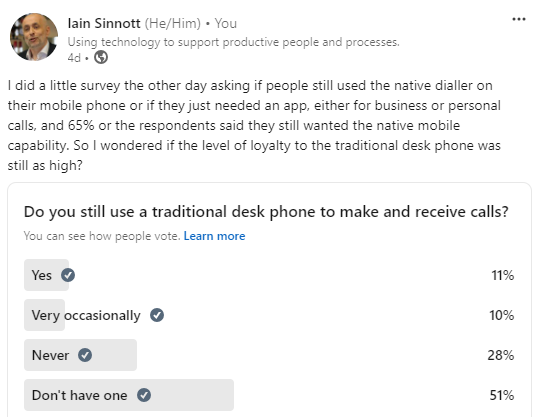
So, when I ran a survey on LinkedIn last week it was no surprising to see 78% of respondents never used a desktop phone, with over 50% of the total responders not even having one, but is that significant and if so, why?
With flexible working comes flexible communication channels
Well, the answer possibly depends on the role you have within your business. For admin and knowledge workers this change is significant as it means that both businesses and customers have shifted from relying solely on traditional telephony. Now, they may prefer to communicate through a variety of channels rather than a simple voice call.
This suggests you may need laptop or mobile access to chat, synchronous & asynchronous voice, virtual meetings and text to meet their expectations. In a competitive environment, there is now an arms race to provide the right contact medium for the customer at any point in a 24/7/365 response-driven world.
The driver for this change was flexible working. Businesses using a traditional desk phone may have not had a compelling reason to switch – until now. But accelerated by the pandemic, we embraced hybrid work, bringing with it the need for flexible communication methods.
While many organisations are still working on bringing people back together physically in the office for a greater percentage of the working week, the half-empty Monday and Friday London commuter trains will tell you otherwise.
Flexibility in where people prefer to work is here to stay. Good news for the work-life balance perhaps and a key dynamic which now shapes how businesses start to build their communications systems of the future.
Combine this with the added challenge of offering and managing business grade multi-media contact channels, the preference of youth and the changing habits of customers and you see our reinforced dependence on the multi-media qualities of the laptop and mobile phone.
This doesn’t mean onsite phone systems won’t be needed at all. In some cases, you might do. However, organisations should focus on the crucial mindset shift from needing a ‘desktop phone for everyone’ to ‘an occasional desk phone’.
Should the switch be hard?
This may all sound like a quantum shift looming on the near horizon, but for most organisations, it may be a relatively simple process of shifting from a traditional desk phone to a ‘unified communication and collaboration tool’.
We see quite a few players making big headway in this space, including Microsoft, Zoom and RingCentral serving different marketing segments from enterprise to SMB.
One of the advantages of moving away from your traditional phone system now is that you won’t be dealing with an entirely unfamiliar setup. For instance, if you’re a Zoom user for meetings and collaboration, you can easily upgrade to Zoom telephony solutions within the same familiar interface. You may already be familiar with this alternative system because you’re already using it for your collaboration and internal communication.
What about ROI?
Whilst recognising the day of the desktop phone is about done, except for specific use cases, there is an opportunity for business leaders to examine the new possibilities which could serve their people, their customers and their workplace flexibility. Some of the tools are remarkable and extremely functional, but the ROI calculations may need support from stakeholders from sales & marketing, support and ops teams to HR and CSR/ESG leaders.
Reduction of costs is consistently cited as a main driver for businesses in the comms & collaboration space.
But it does not mean reducing technology spend. It is perhaps more focused on the cost to serve, the cost of sale, recruitment costs, staff salaries and travel costs, all of which can see substantial reductions when the right communications and IT applications are enabled and adopted. Automation, augmentation and collaboration, backed by measurement and evolution flexibility are the keys to unlocking a new wave of potential in your business.
It’s time to discover the art of the possible!