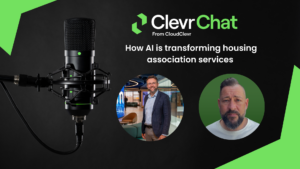
ClevrChat with Ben Lorimer - How local councils can improve citizen experience with practical AI
Summary
AI is transforming local government, but successful adoption isn’t about replacing people; it’s about helping councils deliver better resident services while managing increasing demand and tighter budgets.
In this episode of ClevrChat, Dave Harrison from CloudClevr is joined by Ben Lorimer from Zoom to discuss how local authorities are using AI to modernise customer service, improve contact centre operations and support digital transformation without losing the human touch.
The conversation explores practical AI use cases already delivering value across councils, including virtual agents, AI-powered voice services, intelligent routing, automated case creation and AI-assisted advisors.
Rather than viewing AI as a replacement for frontline staff, the discussion highlights how automation can remove repetitive enquiries, allowing council employees to spend more time supporting residents with complex or sensitive needs.
Dave and Ben also discuss one of the biggest challenges facing local government – ensuring digital transformation remains inclusive. From AI-powered video kiosks in community spaces to providing clear escalation paths to human advisors, they explain why successful AI strategies must support digitally excluded residents alongside those who prefer self-service.
The episode also examines common mistakes organisations make when implementing AI, why incremental deployment often delivers better outcomes than large-scale transformation projects, and how councils can prepare for Local Government Reorganisation (LGR) through flexible cloud communications platforms and open integrations.
Whether you’re a council leader, Head of IT, digital transformation manager or customer experience professional, this episode provides practical insight into how AI can improve resident experience, reduce operational costs and future-proof local authority services.
Timestamps
00:40 Challenges in local authorities: Doing more with less
02:04 Balancing AI and human interaction in council services
04:43 AI implementation: Practical use cases in local authorities
07:00 Taking a step further with an Agentic AI approach
11:30 Common mistakes in digital transformation
15:15 Success stories: Councils getting AI adoption right
20:50 What council leaders should prioritise in the next 12 months
24:10 Things councils are doing today that will be outdated in the near future
Key takeaways
AI should enhance, not replace, human services
Successful councils use AI to automate repetitive, high-volume enquiries while ensuring residents can quickly access a human advisor when needed, especially for complex or vulnerable cases.
Focus on practical AI use cases first
The best AI projects begin with simple, measurable improvements such as answering frequently asked questions, automating service requests and intelligently routing enquiries before expanding into more advanced capabilities.
Digital inclusion remains essential
Technology should make services more accessible, not less. Solutions such as video kiosks, multiple communication channels and assisted digital services help ensure all residents can engage with their local authority.
AI improves both resident and employee experience
AI-powered transcription, summarisation, knowledge retrieval and contextual guidance reduce administration, shorten onboarding time and allow advisors to focus on meaningful conversations with residents.
Adopt an iterative approach to digital transformation
Rather than treating AI as a single transformation project, councils should prioritise quick wins, measure results and continuously improve based on data and user feedback.
Resident outcomes matter more than the technology
Successful AI isn’t measured by the sophistication of the technology but by whether residents receive faster, easier and more effective support.
Prepare now for Local Government Reorganisation (LGR)
Flexible cloud platforms, open integrations and AI-powered services can help councils adapt more easily as organisations merge and services evolve under LGR.